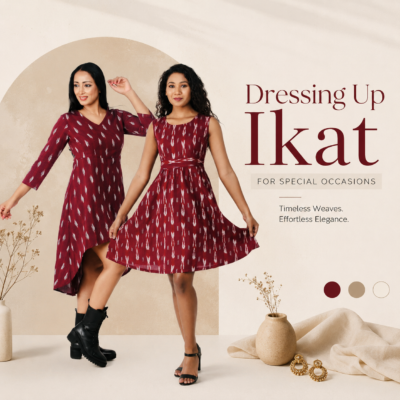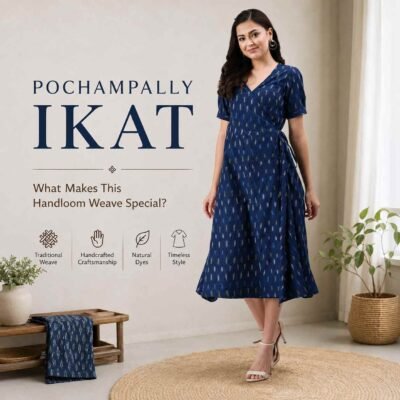
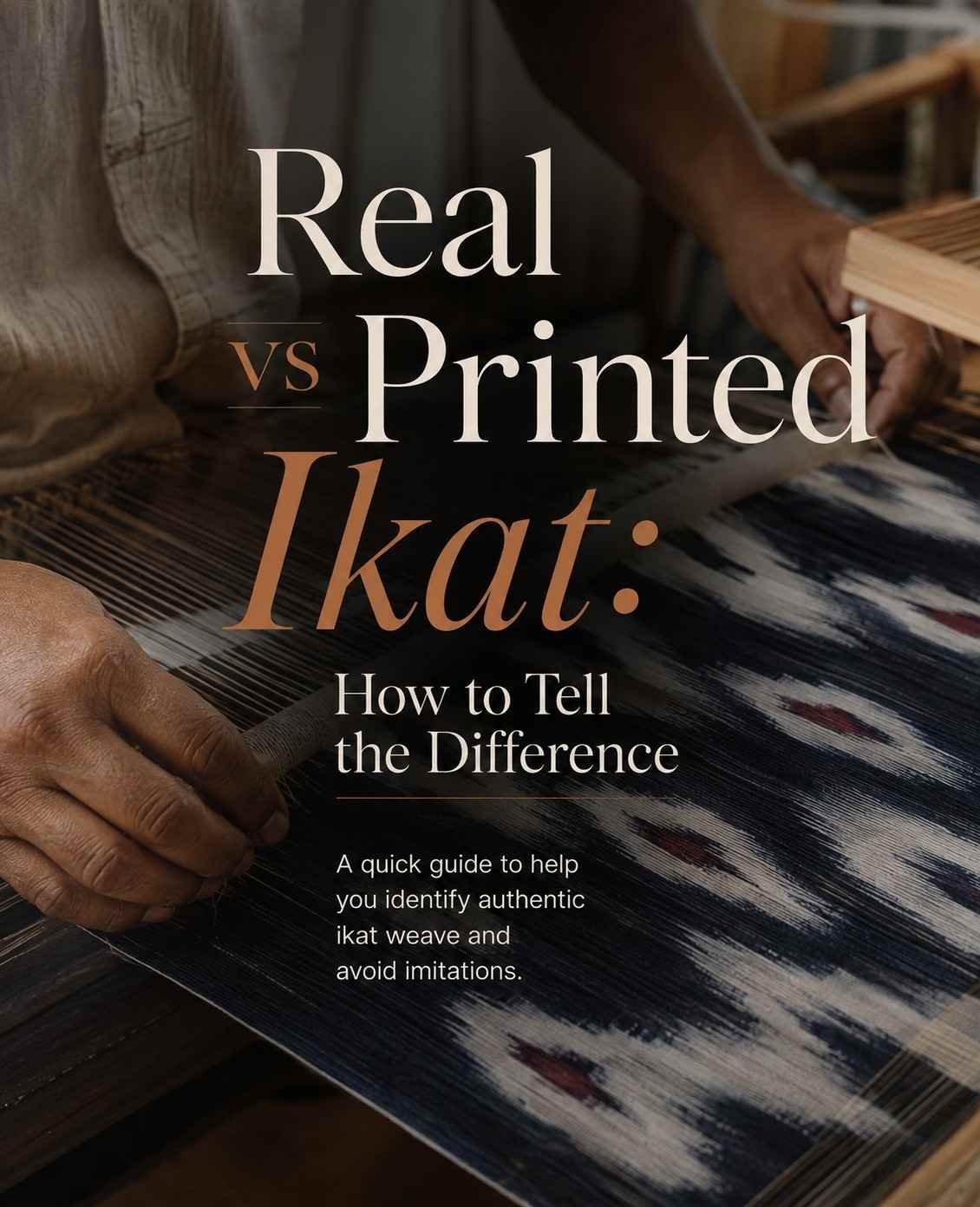
A few months ago, someone messaged us asking why our Ikat handloom dress cost more than a “same design” one she’d found on a fast-fashion app. Fair question. So we sent her a close-up photo of the fabric edge on both — ours, and the one she was comparing it to. She didn’t reply for a bit, and then just wrote back, “oh. these are not the same thing at all.”
That happens a lot. Ikat has become one of those words used loosely across women’s ethnic wear now — Ikat print kurtis, Ikat pattern dresses, Ikat style co-ord sets — and most of it has nothing to do with actual handloom Ikat. It’s just a design printed onto plain cotton because the pattern looks nice. Nobody’s really lying, but nobody’s really telling you the truth either.
So let’s actually clear this up, because once you know the difference, you’ll never look at “Ikat” the same way again.
Real Ikat isn’t printed. It’s dyed before it’s even woven.
This is the part that surprises most people. With real Ikat, the yarn is tied into little bundles and dyed in sections — before the fabric is ever put on a loom. Only after that does the weaving happen. So the pattern you see isn’t sitting on top of the fabric like ink, it’s actually built into the thread itself.
Because the dyed threads move around a little while being woven, the pattern never comes out perfectly sharp. The edges look slightly soft, a bit blurred — almost like the design is breathing. Weavers in places like Pochampally, Sambalpur, and Patan have been doing this exact process by hand for generations. It’s slow, it’s skilled, and honestly, no machine has managed to fake that blur properly. That imperfection is the whole point.
A printed fabric, on the other hand, is just plain cloth with a pattern stamped on afterward. The lines are crisp. Too crisp, if you look closely.
So how do you actually check, standing there with a dress in your hand?
Turn it inside out first. That’s the easiest one. Real handwoven Ikat shows the pattern on the back too, just a shade softer. Printed fabric is usually flat and colourless on the reverse — because the ink never went through the yarn, it just sat on the surface.
Then look at the edges of the pattern itself. Blurred and slightly uneven means it’s real. Sharp, clean, almost too perfect means it was printed.
Run your hand over it. Handloom cotton has a bit of texture to it, a slight unevenness you can actually feel, not the flat smoothness of a printed synthetic blend.
And honestly — check the price against how it’s described. A genuine handloom Ikat piece takes an artisan several days of tying, dyeing, and weaving. If something’s called “handloom Ikat” but priced like a basic printed kurti, one of those two claims isn’t quite true.
Why bother with any of this
Because buying the real thing isn’t just about getting better fabric, though you do get that too — it breathes better, softens with every wash instead of fading, and lasts years longer than anything printed. It’s also about who’s on the other end of that purchase. Every handwoven piece means a weaver somewhere kept their loom running for one more order, instead of that skill slowly disappearing because everyone moved to machine prints because they’re cheaper and faster.
It’s a small choice. But it adds up to whether these weaving traditions survive another generation or not.
And once you have it, wear it like you actually own it
This is where people get stuck a bit — Ikat still feels like “special occasion” clothing to a lot of us, something you save for a wedding or a festival. It really doesn’t have to stay that way.
A knee-length Ikat dress with pockets works just as well for a regular Tuesday at work as it does for anything else. Sneakers, a tote bag, done — nobody needs to know it’s handwoven unless you tell them.
An Ikat co-ord set — top with pants — paired with an old denim jacket stops looking “ethnic” and starts looking like something you just grabbed because it’s comfortable and it works. That’s honestly the best way to wear it, when it stops feeling like a costume and starts feeling like your actual clothes.
For travel, handloom cotton is genuinely one of the better fabrics you can pack — it doesn’t crease the way synthetic stuff does, and it’s breathable enough for long train or flight days. And if you want to dress something up, an Ikat shirt-dress with heels and a bold lip takes you from a desk to dinner without a full outfit change.
One small tip — since the weave already does most of the visual work, don’t pile on jewellery. One statement piece, a cuff or a pair of earrings, is usually enough. Let the fabric be the main thing people notice.
The short version
Real Ikat has a blur to it, shows through on both sides, and takes real time to make — which is exactly why it costs more than the printed copies flooding the internet right now. Once you can spot the difference, it’s hard to go back.
If you want pieces that are actually handwoven — comfortable enough for every day, made by artisans still doing this the traditional way — Abravi’s Ikat handloom collection is a good place to start.