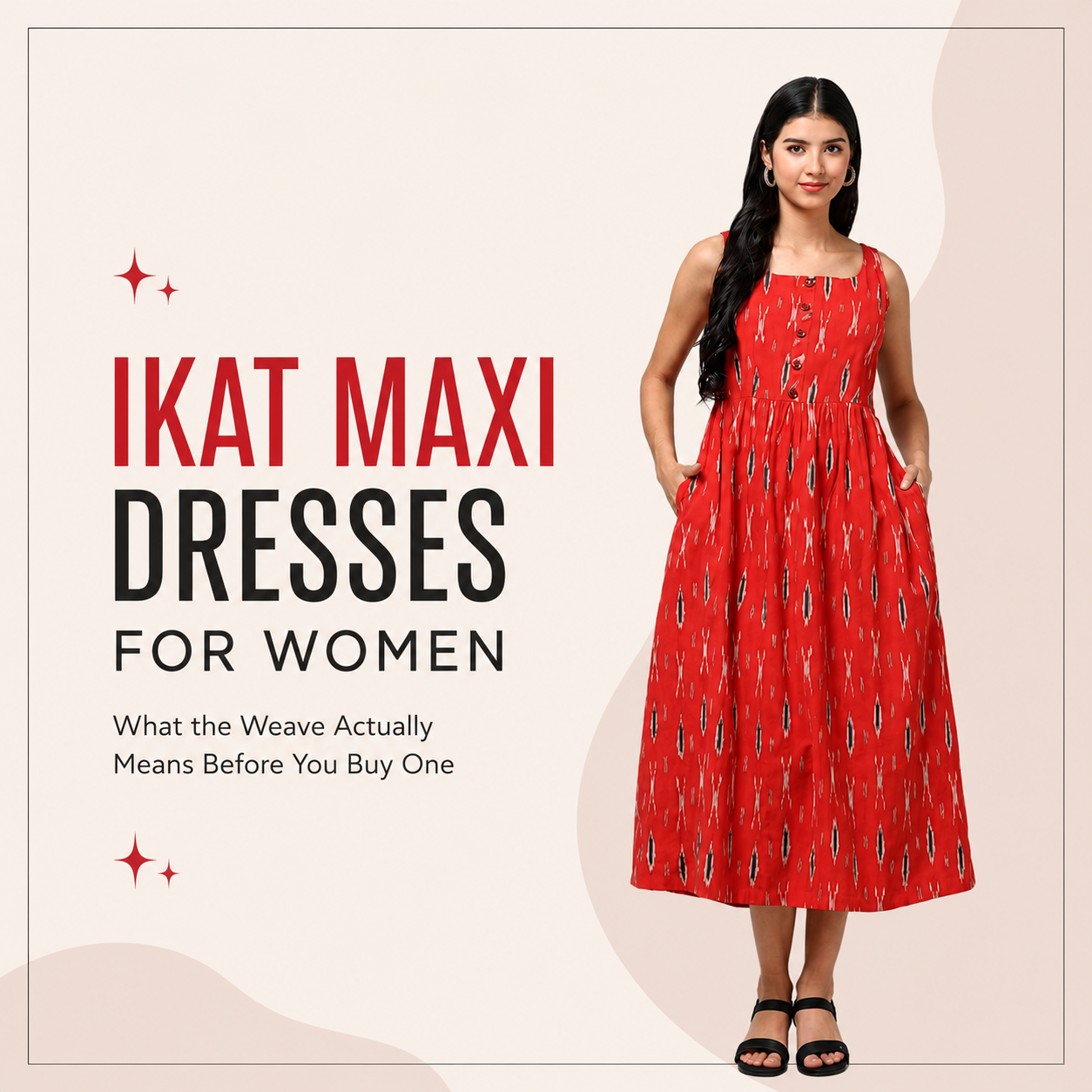
Most maxi dresses for women get picked for one reason — they are easy. One piece, no matching required, done. But an ikat maxi dress asks a slightly different question before you buy it: do you know what you are actually wearing? Because the pattern on it was not printed after the fabric was made. It was decided before a single thread touched the loom.
That difference is worth understanding, because it is also what decides how the dress will look, feel, and hold up over the years.
The Weave Comes Before the Cloth, Not After
Ikat is not a print but a resist dyeing technique. The weavers tie the yarn prior to dyeing . They tie either the warp ( the lengthwise threads ) or the weft ( the crosswise threads ) , or sometimes both , using a resist material . Only the untied parts take the colour. Once the yarn is woven, the dyed and undyed sections line up to form the pattern. If only one set of threads is dyed it is called single ikat. If both warp and weft are dyed and have to be aligned by hand when weaving it is called double ikat, which is much harder to get right, and is the reason why double ikat pieces are noticeably more expensive.
That soft blur you see along the edge of every ikat motif is not a design flaw. It happens because the dyed threads shift slightly during weaving, and it is physically impossible to fake in a machine print. A printed “ikat” pattern will have sharp, clean edges. A woven one never does.
Where This Craft Actually Comes From
A lot of what is sold today as “ikat” online is actually machine printed and has nothing to do with the actual technique. Real handwoven ikat in India is made by a few particular weaving clusters, each with its own signature. The most famous is Pochampally, in Telangana’s Yadadri Bhuvanagiri district, whose diamond and chevron patterns won it a Geographical Indication tag from the Government of India in 2005, a legal protection to prevent machine-made imitations from being sold under the same name. Sambalpuri ikat from Odisha has its own symbolic motifs. Patola from Patan in Gujarat, is the most complex of all – a double ikat so labour-intensive that it can take months for two weavers to finish a single piece.
When a dress is described as “ikat” without naming which weaving tradition it borrows from, that is usually the first sign it is a print, not a weave.
How to Actually Tell the Difference Before You Buy
This is where most buyers get misled, so it is worth knowing what to check:
- Look at the reverse side. On a genuine woven ikat, the pattern is visible on both sides of the fabric, though slightly softer on the back. A printed pattern shows clearly on the front only, with the back looking plain or faded.
- Check the edges of the motif. Woven ikat has that characteristic blur. A crisp, sharply outlined motif is a print.
- Expect small irregularities. No two metres of genuinely handwoven ikat will match perfectly. If the repeat pattern looks machine-perfect and identical throughout, it did not come off a handloom.
Choosing the Right Fit for a Maxi Silhouette
Ikat motifs are already visually busy, so the cut of the dress should not compete with them. A few things matter more than they seem to:
Fabric weight decides drape. Pure cotton ikat is breathable and structured, which suits Indian summers, but it holds its shape rather than flowing. A cotton-silk ikat blend drapes closer to the body and works better if you want movement in the fabric.
Waist definition matters more in a maxi. Because the length already adds volume, an unstructured waist can make the dress look shapeless on most body types. A tie-up waist or an empire cut gives it shape without needing a separate belt.
Keep the neckline quiet. With a strong geometric print already doing the visual work, a simple round or V-neck lets the weave stay the focus instead of competing with embellishment.
Caring for a Handwoven Fabric
Handloom ikat is more durable than most people expect, but it is not machine-wash-and-forget. Hand wash in cold water for at least the first few washes — this is when loose dye is most likely to bleed, especially in cotton ikat with darker tones. Wash it separately until the water runs clear. Dry it in shade, never in direct sun, since UV exposure fades natural and vegetable dyes faster than synthetic ones. Iron on the reverse side to protect the surface of the weave.
Why the Weave Is the Point
A machine-printed maxi dress with an ikat-style pattern will always be cheaper, and there is nothing wrong with buying one if that is what you are looking for. But it is not the same product, and it does not carry the same weight — literally or otherwise. Every genuine ikat maxi dress represents hours of a weaver’s planning before the loom was even threaded, and that is the actual value you are paying for, not just the silhouette.
If you already know this and are looking for one, check whether the seller can tell you which weaving cluster the fabric comes from. If they can answer that question, you are probably looking at the real thing.